
In Hawaii, a roofing license isn't just a piece of paper; it's the only thing standing between your family's safety and a devastating financial liability. You likely already know that finding the best roofing companies Oahu has to offer is about more than just comparing quotes. It's about the peace of mind that comes from knowing your contractor won't disappear when the heavy rains hit or leave you legally responsible for a workplace injury. When you're investing in your home's most critical defense, you shouldn't have to guess if your contractor follows the strict C-42 specialty requirements or carries the necessary workers' compensation insurance.
This guide will teach you exactly how to verify Hawaii roofing licenses and protect your home from common industry scams. We'll explore how to choose a professional built for Oahu's unique climate, from managing salt air corrosion to meeting the latest 160 mph hurricane wind standards. You'll gain a clear understanding of the 2025 "white roof" mandates and the specific legal steps required for a worry-free replacement. By the end, you'll have the confidence to select a partner who respects both Hawaii building codes and your long-term financial security.
Key Takeaways
- Understand why a C-42 Specialty Contractor license is the legal requirement for Hawaii roofing projects and why a general license might not offer the same specialized protection.
- Learn the critical difference between liability insurance and workers' compensation to shield your personal assets from workplace accidents and property damage.
- Discover the step-by-step process for using the Hawaii DCCA Professional and Vocational Licensing search to check for active licenses and past complaints.
- Identify how the best roofing companies Oahu utilize specific materials and techniques to withstand salt air corrosion and meet 160 mph wind uplift standards.
- Explore why partnering with a residential-focused expert ensures your home receives specialized care without the distractions of commercial or solar projects.
What is a C-42 License and Why Does it Matter on Oahu?
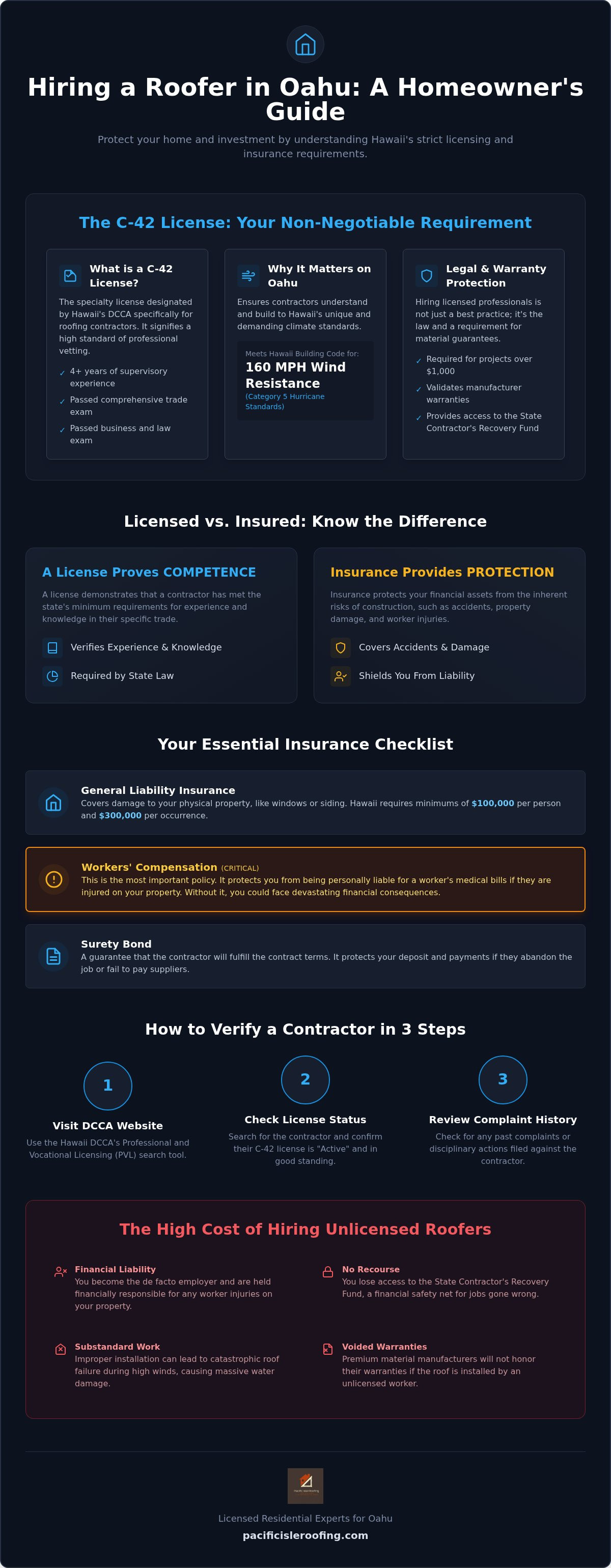
A C-42 license is the specific specialty classification designated by the Hawaii Department of Commerce and Consumer Affairs (DCCA) for roofing contractors. It isn't just a basic permit; it represents a high standard of professional vetting. To obtain this license, an applicant must document at least four years of full-time supervisory experience in the roofing trade within the last ten years. They must also pass a comprehensive trade-specific examination and a separate business and law exam. This ensures that the best roofing companies Oahu has to offer are led by individuals who possess both the technical skill and the legal knowledge to protect your property.
Adhering to local standards is vital for island survival. As of 2026, Hawaii building codes require structures to withstand winds of up to 160 mph, aligning with Category 5 hurricane standards. A licensed C-42 contractor understands these structural requirements and ensures that every fastener and shingle is installed to meet these rigorous Honolulu and Hawaii County codes. Without this specialized oversight, your roof might look fine on the surface but fail when the next major storm hits.
The Legal Requirement for Roofing in Hawaii
Hawaii law is very specific about who can perform construction work. Any roofing project where the combined cost of labor and materials exceeds $1,000 requires a licensed contractor. Hiring an unlicensed handyman for a major repair or replacement isn't just a safety risk; it's a violation of state regulations. The DCCA oversees these standards to protect homeowners from fraud and substandard craftsmanship. If you choose an unlicensed worker, you lose access to the State Contractor's Recovery Fund. This fund acts as a financial safety net for homeowners who suffer damages caused by a licensed professional. Without it, you're left with no recourse if the work is abandoned or fails prematurely.
Specialty vs. General Contractor Licenses
Homeowners sometimes assume a General contractor with a "B" license is the same as a roofing specialist. While general contractors can oversee entire home builds, specialized roofing work requires the precision of a C-42 professional. Other specialty licenses, like a C-33 painting contractor, don't have the training required for structural roof work. This distinction is especially important for your material warranties. Most premium manufacturers won't honor their product warranties unless the installation is performed by a licensed specialty contractor. By choosing one of the best roofing companies Oahu provides, you ensure your investment is protected by both the law and the manufacturer's long-term guarantee.
The Critical Difference Between 'Licensed' and 'Insured' in Hawaii
A Hawaii contractor's license proves that a professional has the experience and knowledge to do the job, but insurance is what protects your bank account when things go wrong. Many homeowners assume these two credentials are the same, yet they serve entirely different purposes. The best roofing companies Oahu homeowners hire will always carry both general liability insurance and workers' compensation. General liability protects your physical property. If a crew accidentally breaks a window or damages your siding during a tear-off, this policy covers the repairs. In Hawaii, licensed contractors must maintain minimum coverage of $100,000 per person and $300,000 per occurrence, providing a baseline of financial safety for your home.
Surety bonds offer another layer of security that insurance doesn't cover. While insurance pays for accidents, a bond is a guarantee that the contractor will fulfill the terms of your contract. If a roofer abandons the project halfway through or fails to pay their material suppliers, you can file a claim against the bond to recover your losses. This financial accountability is a hallmark of a professional operation and ensures your investment doesn't disappear if the company faces internal struggles. It's a vital protection that separates established veterans from transient workers who might offer lower prices but carry significantly higher risks.
Protecting Your Assets with Workers' Comp
Workers' compensation is arguably the most important document you'll ever request from a contractor. Roofing is a high-stakes trade, and Hawaii's medical costs are among the highest in the country. If a worker is injured on your property and the contractor doesn't have active workers' compensation insurance, you could be legally classified as the "employer of record." This exposes you to the "deep pocket" risk, where you're held responsible for medical bills and lost wages. Don't just take a verbal "we're covered" as proof. You should verify their standing through the official license verification portal and request a Certificate of Insurance (COI) sent directly from their insurance agent. This ensures the policy is active and hasn't lapsed due to missed payments.
General Liability for Tropical Storms
Weather on Oahu is famously unpredictable. If a sudden rainstorm hits while your old shingles are removed and the new underlayment isn't yet secure, your home's interior is vulnerable. General liability insurance is what covers the resulting water damage to your drywall, flooring, and furniture. It's also worth noting that many insurance policies are only valid if the contractor is working within the scope of their license. If you hire an unlicensed worker, their private insurance might deny a claim because the work was performed illegally. When you're ready to ensure your home is fully protected, our team can provide detailed roofing inspections to identify any vulnerabilities before the next storm season arrives.
How to Verify an Oahu Roofing Contractor's Credentials
Performing a background check on your contractor is the most effective way to ensure your roof replacement is handled with integrity. While many providers claim to be among the best roofing companies Oahu offers, a professional will always encourage you to verify their credentials through official state channels. This process moves beyond surface-level reviews and looks into the legal standing of the business. Real transparency is the hallmark of a seasoned veteran who has nothing to hide.
The 3-Step DCCA Verification Process
To begin, visit the Hawaii Department of Commerce and Consumer Affairs (DCCA) Professional and Vocational Licensing (PVL) website. Follow these steps to confirm a contractor's standing:
- Enter the contractor's license number, such as C-42-31088, into the search field.
- Confirm the license status is listed as "Active" and "In Good Standing."
- Check for any "Automatic Forfeiture" or "Suspended" statuses, which indicate a failure to maintain insurance or pay required fees.
You should also verify the Responsible Managing Employee (RME) status. The RME is the individual whose specific trade experience allowed the company to obtain its license. They must be actively involved in the company's operations to ensure every project meets Hawaii's technical standards.
Beyond the License: Local References and Reviews
Longevity on the islands is a powerful indicator of reliability. A company with over 20 years of local history has survived decades of tropical storms and economic shifts. When researching the best roofing companies Oahu provides, ask for references in your specific neighborhood, whether you live in Ewa Beach, Kailua, or Kapolei. A contractor who has successfully completed projects near your home understands how the salt air on the Windward side or the intense sun in Waianae affects specific materials. Cross-referencing DCCA data with feedback from your own community provides a complete picture of a contractor's accountability.
Watch for red flags that suggest a lack of local roots. A contractor using a P.O. Box instead of a physical Oahu office or a phone number without an 808 area code might be a "storm chaser" from the mainland. These transient companies often vanish once the job is finished, leaving you without support if a leak develops later. Understanding the Risks of Unlicensed Roofing in Hawaii is essential; a clean record with the Regulated Industries Complaints Office (RICO) is non-negotiable for anyone working on your home. If a contractor uses pushy sales tactics or demands an immediate signature, it's a sign they prioritize their bottom line over your home's long-term security.
Risks of Unlicensed Roofing in Hawaii's Tropical Climate
Hiring an unlicensed contractor on Oahu is more than a legal gamble; it's a direct threat to your home's structural integrity. While the best roofing companies Oahu provides prioritize materials that withstand our harsh tropical environment, unlicensed workers often cut costs by using standard mainland fasteners and flashing. In coastal neighborhoods like Aina Haina, salt air corrosion can destroy sub-standard metal in just a few years. Licensed professionals are trained to use specific stainless steel or high-grade aluminum components that resist this 'salt creep,' ensuring your roof remains secure during high-wind events. These details are often overlooked by those who don't answer to state licensing boards.
Proper attic ventilation is another area where unlicensed work often fails. Hawaii building codes mandate specific airflow ratios to combat our high humidity. Without this, trapped heat and moisture lead to 'hidden' rot in the plywood decking and dangerous mold growth in the attic space. A licensed roofer ensures these ventilation standards are met, protecting both the roof's lifespan and your family's health. By adhering to the 160 mph wind uplift requirements mentioned earlier, a professional installation provides the durability needed to survive Category 5 hurricane conditions.
Oahu's Unique Weather Challenges
The intensity of tropical weather requires specialized installation techniques that go beyond basic shingle placement. In areas prone to heavy tropical rains, licensed contractors prioritize high-performance waterproof underlayment. This secondary barrier is critical when the primary roofing material is compromised. An unlicensed 'handyman' might skip this step to offer a lower price, leaving your home vulnerable to water intrusion. Licensed inspections are designed to catch these vulnerabilities, identifying structural rot caused by humidity before it becomes a catastrophic failure.
Insurance and Warranty Complications
The financial fallout of unlicensed work often arrives years after the project is complete. Major manufacturers like GAF or Owens Corning strictly void their material warranties if the installation wasn't performed by a licensed C-42 professional. This means a 30-year shingle could become a total financial loss if a manufacturing defect occurs. Additionally, your homeowner's insurance policy may contain clauses that deny coverage for leaks or wind damage if the work was performed by an unlicensed entity or without the required city permits.
Selling an Oahu home with unpermitted or unlicensed roof work can stall a real estate transaction during the disclosure process. Buyers and lenders increasingly demand a licensed roof inspection report to verify the structure's safety and code compliance. If you're concerned about the state of your current roof or need to verify a previous installation, scheduling professional roofing inspections is the best way to document its condition and ensure it meets current safety standards.
Choosing Pacific Isle Roofing: Licensed Residential Experts
Selecting a partner for your home's protection requires more than just looking at a price tag. At Pacific Isle Roofing, we've built our reputation on the bedrock of local accountability and technical excellence. We hold Hawaii license C-42-31088, a designation that reflects our strict adherence to state standards and our commitment to the safety of our neighbors. Unlike many of the best roofing companies Oahu offers, we focus 100% on residential projects. By avoiding the distractions of commercial contracts or solar installations, we ensure our specialized skills are dedicated entirely to the nuances of home roof replacement and repair.
Our mission is driven by a desire to provide long-term security for families across the island. We understand that a roof is a structural investment that must survive decades of intense sun and heavy tropical rain. Because we're locally owned and operated, we don't just work in these communities; we live in them. This proximity ensures that we remain responsive and transparent throughout every phase of your project. We prioritize premium materials and disciplined craftsmanship to ensure your home remains a safe haven.
A Legacy of Local Service
With over 20 years of history serving Honolulu, Kaneohe, Pearl City, and beyond, we've seen firsthand how Oahu's microclimates affect different materials. Our neighborly approach is built on clear, honest communication. We don't believe in high-pressure sales tactics. We act as a guide to help you navigate building codes and material selections. Whether you live in a high-wind zone or a coastal area prone to salt spray, our work is tailored to the specific environmental pressures your home faces. This local expertise is why we're consistently ranked among the best roofing companies Oahu homeowners trust for their most valuable asset.
Get Started with a Professional Assessment
Every successful roofing project begins with a thorough understanding of the current structure. When you schedule a consultation, we provide a detailed assessment that meets Hawaii's strict residential standards. We look for the signs of rot, moisture intrusion, and structural wear that others might miss. You'll receive a comprehensive report that outlines exactly what your home needs to remain safe and code-compliant for years to come. This thoroughness suggests a high level of preparation and a focus on getting every detail right from the beginning.
Choosing a fully licensed and insured partner means you're protected from the liability risks discussed earlier in this guide. We provide the documentation you need for your insurance carrier and the peace of mind you deserve as a homeowner. Don't leave your home's safety to chance. Schedule your professional Oahu roof inspection with Pacific Isle Roofing today!
Protecting Your Island Home for the Long Term
Your roof is your home's primary defense against Oahu's unique environmental challenges. Choosing among the best roofing companies Oahu provides means prioritizing legal protection and technical expertise over the lowest bid. You now know how to verify a C-42 license and why workers' compensation is essential for shielding your family from liability. By selecting a contractor who understands tropical weather patterns, you ensure your investment survives salt air and heavy rains for decades to come.
Pacific Isle Roofing brings over 20 years of local residential experience to every project. We hold Hawaii license C-42-31088 and specialize exclusively in residential leak repairs and full replacements. Our focus remains on providing clear communication and disciplined craftsmanship for our neighbors across the island. We're ready to help you navigate the complexities of building codes and insurance requirements with confidence.
Secure your home with Oahu's licensed residential experts-Contact Pacific Isle Roofing
We look forward to helping you protect your home with the integrity and specialized care it deserves.
Frequently Asked Questions
Is a general contractor license enough for my roofing project on Oahu?
A general contractor's "B" license isn't a substitute for a C-42 roofing specialty license when it comes to structural roof work. While generalists can manage broad construction, they often lack the specific trade experience required for specialized roofing systems. Hiring a dedicated C-42 professional ensures your home meets the latest 160 mph wind standards. It's the only way to guarantee your manufacturer's material warranty remains fully valid.
How can I verify a Hawaii roofing license number?
You can verify a license number using the official Hawaii DCCA Professional and Vocational Licensing search portal. Simply enter the contractor's number, such as C-42-31088, to see their current standing. A status of "Active" and "In Good Standing" confirms they've met state requirements. This tool also allows you to check for "Automatic Forfeiture," which happens if a contractor fails to maintain their mandatory insurance coverage.
What are the risks of hiring an unlicensed roofer in Hawaii?
Hiring an unlicensed roofer exposes you to immense financial liability and structural risks. Unlicensed workers can't pull city permits, meaning your roof won't undergo official safety inspections. You also lose access to the State Contractor's Recovery Fund, which provides financial recourse if a licensed professional fails to perform. If the work is substandard, you're left with no legal protection and potentially a roof that won't survive the next tropical storm.
Does Hawaii law require a written contract for roofing work?
Hawaii law mandates a written contract for any residential project where the total cost exceeds $1,000. This document must clearly state the contractor's license number and provide a specific description of the services being performed. A signed contract is your primary legal protection. It ensures both you and the contractor are aligned on the project's timeline, the materials being used, and the total financial commitment required for the job.
What is the difference between a C-42 and a C-33 license?
The C-42 license is specifically for roofing, whereas the C-33 license is restricted to painting and decorating. Some painters may offer to apply "cool roof" coatings, but they aren't authorized to perform structural repairs or shingle replacements. For any work involving the integrity of your roof's surface or underlayment, you need a C-42 specialist. This ensures the professional has passed trade-specific exams and holds the necessary supervisory experience.
Will my homeowner's insurance cover damage if the roofer was unlicensed?
Most insurance carriers won't cover damage resulting from work performed by an unlicensed contractor. If a storm causes a leak through a roof that wasn't installed by a licensed professional, your claim could be denied due to "faulty workmanship." Choosing the best roofing companies Oahu provides ensures your installation meets all legal standards. This keeps your policy active and ensures you aren't forced to pay for expensive interior repairs out of pocket.
What should I look for in a roofing contractor's insurance policy?
You should look for active general liability and workers' compensation coverage with specific minimum limits. Hawaii requires contractors to have at least $100,000 per person and $300,000 per occurrence for bodily injury. Workers' compensation is the most vital document for a homeowner. It ensures you aren't legally responsible for medical costs if a worker is injured on your roof. Always request a Certificate of Insurance sent directly from their agent.
How do I check for past complaints against an Oahu roofing company?
You can check for past disciplinary actions through the Regulated Industries Complaints Office, also known as RICO. Their database provides a history of legal actions or complaints filed against both licensed and unlicensed contractors. Reviewing these records is a critical step in your due diligence. It helps you identify the best roofing companies Oahu has to offer by confirming a provider's long-term commitment to professional standards and local community accountability.


