
That small rust spot on your gutter might seem like a cosmetic nuisance, but in Oahu's coastal climate, it is often the first sign of a much deeper metallurgical conflict. Most homeowners invest in metal for its longevity, yet the relentless salt air can turn a premium installation into a liability through silent corrosion and pinhole leaks. If you are noticing orange streaks or hearing unusual rattling during trade winds, securing a professional metal roof repair Honolulu specialist is the most critical step you can take to protect your home's structural deck.
We understand that your home is your most significant island investment, and the fear of rust spreading shouldn't keep you up at night. This article provides the clarity you need to identify early signs of failure, master the local building codes, and understand the ROI of targeted repairs versus full replacements. You will learn how to navigate the 25% rule and select materials designed to withstand 150 mph winds. Our goal is to give you the confidence to make informed decisions that ensure your roof remains a steadfast pillar of safety for decades to come.
Key Takeaways
- Identify how sodium chloride and intense UV exposure accelerate "red rust" and why standard patches often fail in coastal environments.
- Master the technical process of metal roof repair Honolulu professionals use to restore protective barriers, from specialized surface preparation to PVDF touch-up coatings.
- Gain clarity on the "25% rule" and how to evaluate your roof's structural deck to choose the most cost-effective path between repair and replacement.
- Understand the critical role of material matching and moisture detection in maintaining a leak-free home that withstands tropical storms and trade winds.
- Learn why hiring a licensed local contractor with 20+ years of experience is essential for meeting Oahu’s updated 150 mph wind speed building codes.
Identifying the Culprits: Why Metal Roofs Leak in Honolulu
Honolulu's environment is exceptionally demanding on residential structures. While a Metal roof is celebrated for its durability and longevity, the specific metallurgical challenges of the Pacific require a specialized approach to maintenance. Understanding why these systems fail in our tropical climate is the first step toward effective metal roof repair Honolulu residents can trust to last for decades. The salt air, intense UV rays, and persistent trade winds all work in tandem to find the smallest weaknesses in your home's defense.
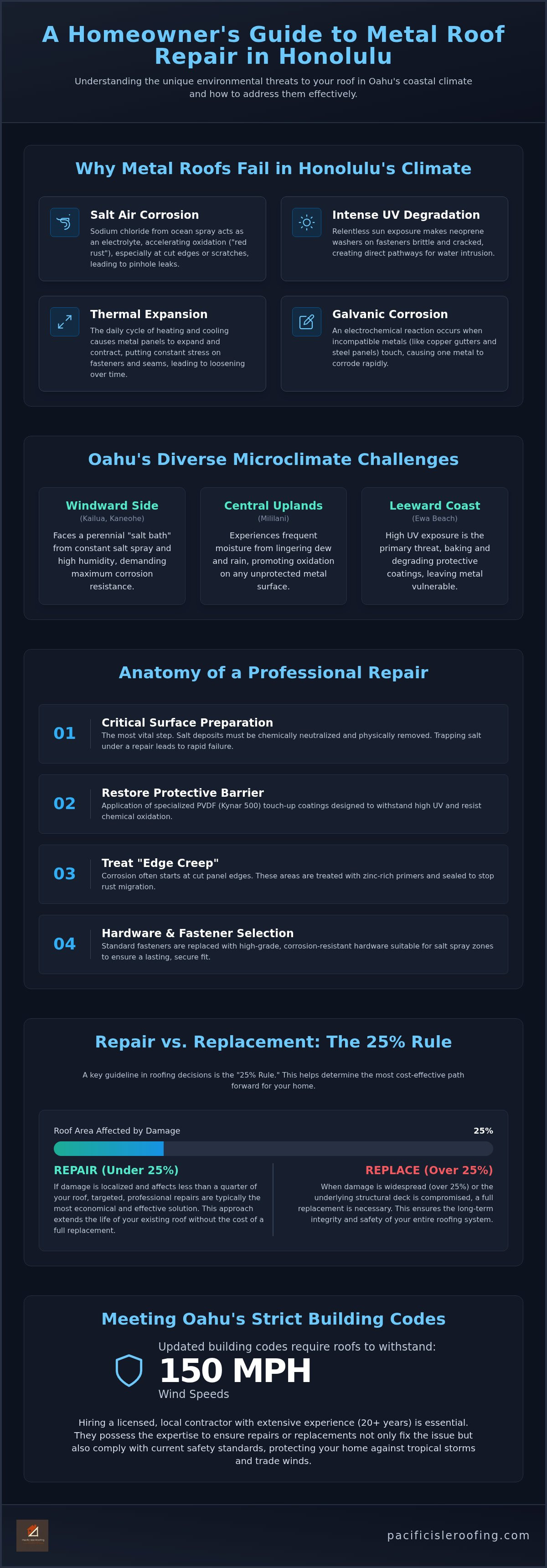
Salt air corrosion is the primary adversary for any coastal property. Sodium chloride from the ocean acts as a powerful electrolyte, accelerating the oxidation of steel panels. This process, often called "red rust," typically begins at cut edges or where scratches have compromised the factory finish. Once the protective coating is breached, the corrosion spreads beneath the surface, eventually creating pinhole leaks that threaten your home's structural deck. Other common culprits include:
- Thermal Expansion: In the intense Honolulu sun, metal panels "breathe" as they expand and contract. This constant movement puts immense pressure on fasteners and seams.
- UV Degradation: Neoprene washers on exposed fastener systems become brittle and crack under the sun's rays, allowing water to seep into screw holes.
- Galvanic Corrosion: This occurs when incompatible metals, such as copper gutters or lead flashing, touch steel panels, causing a chemical reaction that eats away at the metal.
- Debris Buildup: Trapped leaves and organic matter in roof valleys hold moisture against the surface, leading to "crevice corrosion" that can bypass even high-quality coatings.
The Impact of Oahu’s Microclimates
Oahu’s diverse weather patterns mean a roof in Kailua faces different challenges than one in Mililani. On the windward side, in communities like Kaneohe and Kailua, constant salt spray and high humidity create a perennial salt bath for metal surfaces. Conversely, the cooler uplands of Mililani and Central Oahu experience frequent moisture-driven oxidation due to lingering dew and rain. In Ewa Beach, the primary concern is often high UV exposure, which can prematurely bake off protective coatings and leave the underlying metal vulnerable to the elements.
Common Failure Points in Residential Metal Roofing
Many leaks originate at the points where the roof is most vulnerable to movement and wind. Loose fasteners are a frequent issue because trade winds can cause panels to vibrate slightly, which eventually backs out screws and creates entry points for water. Cracked flashing around vent pipes and solar mounts is another common culprit, as the sealants used in these areas may fail before the metal itself does. We also look for "oil canning," which refers to the visible waviness or buckling in the flat areas of metal panels, and it often serves as a warning sign of structural stress or thermal movement that has exceeded the roof's design limits.
Specialized Repair Solutions for Oahu’s Salt Spray Zones
Repairing a metal roof in a coastal environment requires more than just a simple patch and sealant. In Honolulu, the presence of airborne sodium chloride creates a chemical challenge that standard mainland repair methods fail to address. Surface preparation is the most critical phase of any metal roof repair Honolulu project. Before any new coating or patch is applied, salt deposits must be chemically neutralized and physically removed. If salt is trapped beneath a repair, it continues to eat away at the steel, leading to a rapid failure of the new material.
Once the surface is pristine, we focus on restoring the protective barrier using PVDF (Kynar 500) touch-up coatings. These specialized finishes are designed to withstand the high UV index of the Pacific while providing a shield against chemical oxidation. We also pay close attention to "edge creep," which is corrosion that begins at the cut ends of panels where the factory coating is absent. Treating these edges with zinc-rich primers and sealing them prevents the rust from migrating up the panel. If you suspect your roof's protective layer is failing, a professional roofing inspection can identify these microscopic breaches before they become structural problems.
Hardware selection is equally vital in salt spray zones. We replace standard carbon steel fasteners with high-grade 304 or 316 stainless steel or ZAC (Zinc-Aluminum-Cast) screws. These materials are inherently resistant to the galvanic reactions that cause standard screws to rust and fail. To ensure a watertight seal, we utilize high-temperature, UV-resistant polyether sealants. Unlike cheaper alternatives, these sealants remain flexible through thousands of thermal expansion cycles and won't degrade under the intense Hawaiian sun.
Fastener Remediation: Hidden vs. Exposed Systems
Residential metal roofs on Oahu typically fall into two categories: hidden fastener (standing seam) or exposed fastener systems. Exposed fasteners require proactive maintenance, as the neoprene washers usually need re-sealing or replacement every 10 to 15 years due to UV brittleness. In cases where trade winds have vibrated the panels, we often upgrade to oversized washers to properly seal enlarged screw holes. Standing seam systems offer better protection but are more complex to repair, often requiring specialized tools to navigate the interlocking ribs without damaging the finish.
Flashing and Detail Repairs
Flashing is the most common leak site, yet it's often the most poorly repaired. We custom-bend new flashing to match the specific profiles of Honolulu homes, ensuring a seamless fit that resists wind uplift. For chimneys and large vents, we install "cricket" flashing to prevent water from damming behind the structure. It's vital to use the correct bonding agents during this process; silicone sealants are often unsuitable for metal roofing because the acetic acid in some formulas can corrode the finish or fail to bond permanently with Kynar-based coatings.
Repair vs. Replacement: Making the Strategic Choice for Your Home
Deciding between a targeted repair and a complete system overhaul is a high-stakes financial choice for any homeowner. In our local market, this decision isn't just about budget; it's often dictated by the Honolulu Department of Planning and Permitting. The "25% rule" is a critical threshold. If the necessary metal roof repair Honolulu project covers more than a quarter of your total roof surface, the building code mandates a full replacement. This regulation ensures that older, compromised structures are brought up to current safety standards, particularly regarding our updated 150 mph wind speed requirements.
Beyond the surface, we must evaluate the structural deck. Metal panels are excellent at masking what lies beneath them. If moisture has bypassed the underlayment, the plywood decking or rafters may be suffering from rot that isn't visible from the ground. A steel roof that has survived 20 years in Honolulu's salt air is likely nearing the end of its functional life. While it might still look solid, the metallurgical integrity is often compromised by "rust from the inside out" caused by condensation trapped between the panel and the deck. For coastal homes, we often recommend an "Aluminum Upgrade." Aluminum is naturally resistant to salt air corrosion, making it a more durable long-term investment than steel in salt spray zones. Furthermore, modern "Cool Roof" coatings on new systems reflect significantly more solar radiation than older metal, leading to noticeable energy efficiency gains and lower cooling costs.
Long-Term ROI of Metal Upgrades
Investing in a new system offers financial benefits that extend beyond leak prevention. Properties with modern metal roofs often see higher valuations in the Honolulu real estate market due to their perceived durability. Additionally, many insurance providers offer premium reductions for homes equipped with hurricane-rated metal systems that meet the newest High-Velocity Hurricane Area standards. While the upfront cost is higher, the reduction in bi-annual maintenance and the elimination of recurring repair bills often result in a lower total cost of ownership over time. Choosing a licensed professional ensures your roof replacement services comply with all local codes.
When Replacement is the Only Safe Option
There are specific scenarios where repairs are no longer a viable or safe path forward. We look for these critical indicators of systemic failure:
- Extensive Underside Corrosion: When rust begins on the interior side of the panel, the structural strength of the metal has vanished.
- Widespread Fastener Failure: If the screw holes in the decking have enlarged to the point where they no longer grip, the roof's wind uplift rating is severely compromised.
- Structural Deck Damage: Significant rot in the plywood or rafters requires the removal of the metal to restore the home's foundational safety.
The Anatomy of a Professional Metal Roof Repair Process
Executing a professional metal roof repair Honolulu project requires a methodical approach that prioritizes long-term stability over quick fixes. Our process begins with a comprehensive inspection that utilizes moisture meters to identify water trapped beneath the panels. These tools allow us to find hidden leaks within the underlayment before they cause visible damage to your interior ceilings. By pinpointing the exact source of moisture, we avoid unnecessary teardowns and focus our efforts where they are needed most.
Material sourcing is the next critical phase. We take great care to match the existing gauge of your roof, typically choosing between 24 and 26-gauge metal to ensure structural consistency. Using a thinner material for a patch can create weak points that fail during high-wind events. Every repair we perform is designed to meet or exceed Honolulu County building standards, including the rigorous 150 mph wind speed requirements. Our teams follow strict safety protocols to navigate the steep slopes of Oahu’s residential neighborhoods, especially when trade winds make handling large metal panels dangerous. Once the work is done, we conduct a "water test" to simulate a tropical downpours and verify that every seam and fastener is completely watertight.
The Importance of Material Matching
In the world of metal roofing, compatibility is everything. Mixing different metal alloys, such as placing a steel patch on an aluminum roof, triggers rapid galvanic corrosion that can destroy a panel in just a few seasons. We specialize in sourcing specific profiles like 7.2 Rib or Shur-Lock that are common in Honolulu’s older residential communities. Achieving color consistency is also a priority; we select coatings that account for the natural sun-fading caused by our intense tropical UV rays to ensure the repair blends seamlessly with your existing roof.
Hiring Licensed Hawaii Roofing Contractors
Hiring a qualified professional is the only way to ensure your home remains compliant with Hawaii’s strict building codes. You should always verify that your contractor holds a valid Hawaii Contractor License, such as C-42-31088, which provides essential consumer protection and ensures the work is insured. Our team’s 20+ years of experience is focused exclusively on residential structures, where the detailing around dormers and valleys is far more complex than on commercial buildings. Handyman repairs often rely on improper sealants that void manufacturer warranties and fail prematurely. If you want to ensure your roof is handled by seasoned experts, you can book one of our professional roofing inspections today.
Secure Your Home with Pacific Isle Roofing’s Expert Craftsmanship
For over 20 years, Pacific Isle Roofing has remained a steadfast pillar of the Oahu residential community. We understand that your home is your most significant island investment, and protecting it requires more than just a standard contractor. It requires a partner with specialized knowledge of Honolulu’s unique salt-air corrosion challenges. Our team focuses exclusively on residential structures, ensuring that every metal roof repair Honolulu project we undertake is handled with the precision and care your family deserves. We don't believe in quick-fix patches that only mask underlying issues; we prioritize high-quality materials and long-term security.
Our commitment to excellence is reflected in our choice of materials and our methodical work process. We select coatings and fasteners specifically designed to withstand Hawaii’s intense humidity and relentless UV rays. This disciplined approach ensures that your roof remains a durable shield against tropical storms and trade winds. By choosing a seasoned professional with deep local roots, you gain the peace of mind that comes from knowing every detail of your home’s protection has been managed with integrity and specialized skill.
Our Neighborly Approach to Service
Local accountability is at the heart of everything we do. Because we live and work in the communities we serve, we treat every home as if it were our own. This neighborly dedication means you can expect transparent communication from the first inspection through to the final walkthrough. We take pride in our ability to identify "hidden" damage before it becomes a catastrophe, saving you from the stress of unexpected structural rot or deck failure. Our goal is to maintain a high register of professionalism while providing the welcoming, customer-centric warmth that defines island life.
Ready to Protect Your Island Investment?
A professional residential roof health check is the first step toward securing your home for the next several decades. We handle all the heavy lifting, from navigating the complexities of Honolulu County permitting to sourcing the exact metal profiles needed for a seamless look. You don't have to navigate the technical world of Hawaii building codes alone. Let our seasoned veterans provide the authoritative guidance you need to make an informed decision about your roof's future. Schedule your professional metal roof assessment with Pacific Isle Roofing today!
Protecting Your Home Against the Pacific Elements
Maintaining a metal roof in Oahu's salt-heavy environment requires a disciplined approach and a deep understanding of local metallurgy. We have explored how to identify early signs of red rust, the technical nuances of salt-spray zone repairs, and the critical regulatory thresholds like the 25% rule. By addressing these issues with specialized materials and licensed expertise, you ensure your home remains a safe haven for your family through every tropical season.
Pacific Isle Roofing brings 20+ years of local residential experience and the technical authority of Hawaii Contractor License C-42-31088 to every project. We specialize in salt-air corrosion mitigation and high-standard craftsmanship that stands the test of time. Choosing the right specialist for metal roof repair Honolulu ensures your investment is protected by someone who understands our unique coastal challenges. We invite you to Request Your Expert Metal Roof Repair Quote from Pacific Isle Roofing and secure your home's future today. Your peace of mind is our primary mission, and we look forward to serving as your trusted neighbor in roof protection.
Frequently Asked Questions
Is it worth repairing a rusted metal roof in Honolulu?
It depends entirely on the depth and location of the oxidation. Surface rust can often be neutralized and recoated to extend the life of your system, but if the corrosion has created pinholes or originated on the underside of the panel, the metal has lost its structural integrity. In these cases, a targeted repair is merely a temporary fix, and you should consider a partial or full replacement to ensure your home remains watertight during tropical storms.
How much does a typical metal roof repair cost on Oahu?
Costs vary significantly based on the height of your home, the roof's pitch, and the specific materials needed for the job. Factors such as the extent of the corrosion and the accessibility of the leak site will influence the final estimate. While minor fastener replacements are straightforward, complex flashing repairs involving custom-bent metal require more labor. We recommend a professional inspection to receive an accurate assessment tailored to your residential structure.
Can salt air damage a metal roof even if it’s not near the beach?
Yes, salt air is a pervasive issue across the entire island of Oahu. Trade winds carry corrosive sodium chloride particles several miles inland, affecting homes in Mililani and Central Oahu just as they do in Kailua. While the concentration of salt is higher near the shoreline, any metal surface on the island is subject to accelerated oxidation if it isn't properly maintained with high-quality protective coatings designed for the tropics.
Why is my metal roof leaking only during heavy trade wind rain?
This phenomenon is often caused by wind-driven rain pushing water into areas it doesn't usually reach. During heavy trade winds, rain can be forced horizontally or even "uphill" into small gaps in the flashing or under the laps of the metal panels. These entry points may stay dry during a vertical downpour but fail when the wind provides enough pressure to force water past sealants that have become brittle or aged over time.
Do I need a permit for a minor metal roof repair in Honolulu?
Minor maintenance and small patches generally don't require a building permit from the Honolulu Department of Planning and Permitting. However, if your metal roof repair Honolulu project involves structural changes or exceeds 25% of the total roof area, a permit is mandatory. It's always best to work with a licensed contractor who understands the local building codes to ensure your home stays compliant and safe under Hawaii law.
How long does a professional metal roof repair typically take?
Most residential metal repairs are completed within one to two days. The timeline depends on the complexity of the leak and the availability of matching metal profiles for your specific roof. If we need to custom-fabricate specific flashing or wait for a break in the weather to ensure a dry surface for sealants, the process may take slightly longer. We prioritize a methodical pace to ensure every detail is handled correctly the first time.
Can I walk on my metal roof to check for leaks myself?
We strongly advise against walking on your roof without professional training and safety gear. Metal panels can be incredibly slippery, especially when wet or covered in a fine layer of ocean salt. Additionally, walking on certain profiles can cause denting or "oil canning," which may lead to further leaks or damage the protective finish. A professional uses specialized safety equipment and knows exactly where to step to avoid causing structural damage.
What is the best material for a metal roof replacement in coastal Hawaii?
Aluminum is the superior choice for coastal Hawaii homes due to its inherent resistance to salt air corrosion. Unlike steel, aluminum doesn't rust when the surface is scratched or exposed to the elements. For homeowners seeking the highest level of durability, we often recommend 0.032" or 0.040" gauge aluminum panels with a PVDF coating. These materials provide the best long-term protection against our unique tropical climate and high UV exposure.


