What if the very air that makes Honolulu a paradise is quietly dismantling the structural integrity of your home's most important defense? It's a reality for many on Oahu who discover that salt spray and humidity are the silent killers of a residential roof. You likely understand that our tropical climate requires a higher standard of care than a typical mainland property. A professional roof inspection Honolulu homeowners rely on is about more than just spotting leaks. It's about identifying structural vulnerabilities before they turn into major repair costs.
In this guide, you'll discover how a thorough assessment protects your home from tropical storms and preserves its long-term value. We'll provide a clear roadmap for maintenance and help you gain the documentation needed for insurance or a future home sale. From understanding 2026 building codes to preparing for 160 mph wind requirements, you'll learn how to keep your household safe and secure.
Key Takeaways
- Learn why a professional roof inspection Honolulu residents trust is a comprehensive health check that identifies structural vulnerabilities before they become costly leaks.
- Understand the specific ways that salt air and high humidity accelerate the deterioration of metal flashing and shingles in coastal neighborhoods.
- Discover the two-step assessment process that covers everything from gutter drainage to surface-level shingle integrity.
- Identify when to schedule your next assessment based on your roof's age and recent Oahu weather patterns.
- Learn how to verify professional credentials like the Hawaii C-42 license to ensure your contractor has the necessary local expertise.
What is a Professional Roof Inspection in Honolulu?
A professional roof inspection Honolulu residents prioritize is much more than a cursory glance from the street. It is a methodical, top-down evaluation designed to identify hidden weaknesses before they manifest as ceiling stains or structural rot. While many contractors offer a "free estimate," these are typically focused on the cost of a full replacement. In contrast, a professional health check is an objective audit of your roof’s current lifespan, surface condition, and structural soundness. This distinction is vital for maintaining property value in the competitive Oahu market, where a well-documented maintenance history can be a significant asset during a home sale.
This specialized service aligns with the broader standards of a professional home inspection, yet it dives deeper into the specific mechanics of water-shedding systems. By focusing on the long-term integrity of the structure, homeowners gain a clear roadmap for maintenance rather than a high-pressure sales pitch. Our approach at Pacific Isle Roofing stems from over 20 years of local experience, ensuring that every assessment reflects the reality of living on an island where the environment is constantly testing your home's defenses.
The Difference Between Residential and Commercial Inspections
Residential roofing requires a specific set of skills that differ significantly from commercial work. While commercial buildings often feature flat, membrane-based systems, Honolulu homes typically utilize asphalt shingles, clay tiles, or metal panels. These materials rely on complex flashing points and precise attic ventilation to manage heat and moisture. A residential specialist understands that a roof is a breathing system; if the attic ventilation is blocked, even the newest shingles will fail prematurely. Pacific Isle Roofing holds Hawaii license C-42-31088 and focuses exclusively on these residential nuances, avoiding the distractions of commercial or solar projects to ensure your family's home receives our full attention.
Why Honolulu’s Climate Demands a Specialized Approach
Hawaii's micro-climates create unique stressors that a standard mainland checklist simply won't capture. The persistent, heavy rainfall in Kaneohe requires a different focus on drainage and moss prevention than the intense UV exposure and heat found in Ewa Beach. Salt air is another factor that can corrode standard fasteners in a matter of years if they aren't high-grade stainless steel or properly protected. A Honolulu roof inspection is a specialized audit of water-shedding integrity and environmental resilience. It accounts for these local variables, ensuring your roof remains a stable pillar of protection against the elements.
What to Expect During Your Oahu Roof Assessment
A disciplined assessment follows a logical sequence to ensure your home remains watertight. When you schedule a professional roof inspection Honolulu homeowners trust, the process should be thorough, transparent, and methodical. We believe in an "outside-in" approach that begins at the ground level and moves toward the most vulnerable points of the structure. This detailed roof inspection Honolulu residents receive provides a clear baseline for insurance documentation and future maintenance planning.
The standard process involves five distinct stages:
- Step 1: Exterior Perimeter Check: We examine the ground and the roofline for signs of gutter failure, sagging fascia, or excessive debris that could trap moisture against the structure.
- Step 2: Surface-Level Analysis: This involves a close look at your roofing material. We check for granule loss on asphalt shingles, cracked or slipped clay tiles, and any signs of corrosion on metal panels.
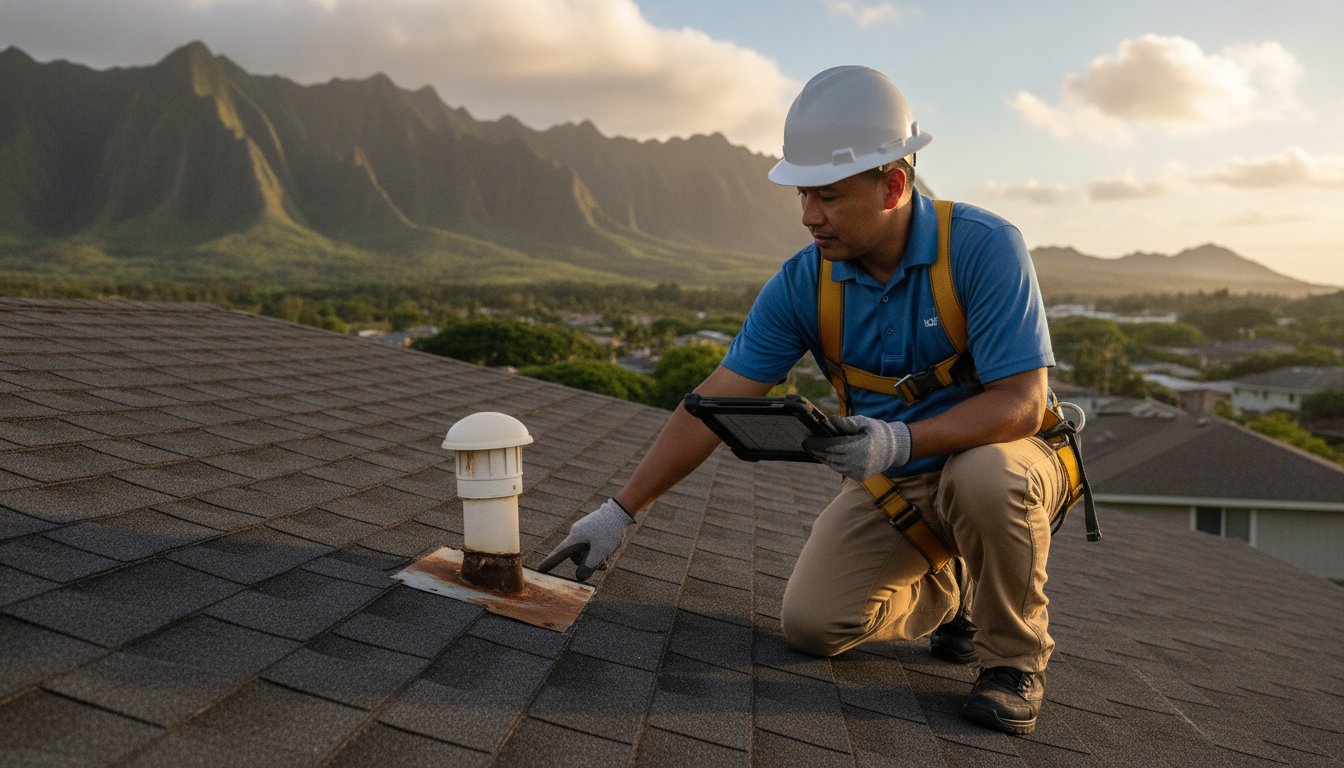
- Step 3: Penetration Inspection: Most leaks begin at "penetrations" like vents, chimneys, and skylights. We verify that the sealants are flexible and the flashing is securely seated.
- Step 4: Attic and Interior Audit: By checking the underside of the roof deck, we can spot "ghost leaks" or wood rot that hasn't yet reached your interior ceiling.
- Step 5: Comprehensive Health Report: You receive a documented summary of all findings, including photo evidence and a prioritized list of any necessary repairs.
Physical Inspection vs. Drone Technology
Modern assessments often utilize high-resolution drone imagery to capture angles that are difficult or dangerous to reach. Drones provide an excellent overview of steep slopes and high peaks, but they cannot replace a manual check. A seasoned professional needs to physically touch the sealant and feel the "crunch" of a damaged shingle to truly understand its condition. At Pacific Isle Roofing, we combine advanced drone technology with 20 years of seasoned intuition to provide the most accurate assessment possible.
Evaluating Attic Ventilation and Insulation
The intense Hawaii sun can lead to "roof bake," where trapped heat in the attic causes shingles to curl and fail prematurely. During an assessment, we ensure that intake and exhaust vents are clear of debris to allow for proper airflow. In humid areas like Kailua, poor ventilation often leads to hidden condensation and mold growth. Proper airflow is just as critical to your roof's longevity as the shingles themselves. If you are concerned about the current state of your shingles, a professional roofing inspection can provide the clarity you need to protect your investment.
Identifying Hawaii-Specific Damage: Salt Air, Humidity, and Wind
Oahu’s environment is relentless. A standard roof inspection Honolulu homeowners schedule must account for more than just the age of the materials. It must account for the unique chemical and physical stressors of our islands. While a roof on the mainland might suffer from snow load or hail, a Honolulu roof faces a daily battle against salt spray, high-velocity trade winds, and intense UV degradation. Understanding these specific threats is the first step in ensuring your home remains a stable pillar of protection for your family.
Our 20 years of local experience has shown that damage often begins in ways that are invisible to the untrained eye. For instance, the intense 2026 Hawaii sun accelerates the breakdown of asphalt shingle granules at a rate significantly higher than in temperate climates. Once these granules are lost, the underlying bitumen is exposed to UV rays, leading to brittleness and cracking. In Windward Oahu, persistent trade winds create unique uplift pressures that can loosen shingles over time, even if they appear intact from the ground.
Beyond the sun and wind, biological growth is a constant concern. The "black streaks" often seen on Honolulu roofs are actually a hardy form of algae known as Gloeocapsa magma. These streaks are not merely an aesthetic issue; they trap moisture against the roofing material and can lead to premature decay. A professional assessment identifies these biological threats before they compromise the integrity of the roof deck.
The "Silent Killer": Salt Air and Your Roof
Salt air is perhaps the most pervasive threat to Oahu homes, particularly in coastal neighborhoods like Aina Haina. When salt spray settles on your roof, it initiates a chemical reaction that corrodes standard metal flashing, valleys, and fasteners. We recommend that homes within a five-mile radius of the coast receive more frequent fastener checks. If the nails or screws holding your roof in place begin to rust, the structural connection between the roofing material and the house is compromised. This makes the entire system vulnerable to failure during a tropical storm.
Humidity and the Risk of Roof Rot
In humid regions like Ewa Beach or Pearl City, trapped moisture is a primary cause of plywood delamination. When humidity is high and attic ventilation is poor, moisture can accumulate on the underside of the roof deck. This leads to "spongy" spots in the wood that signify underlying rot. During a disciplined roof inspection Honolulu specialists look for these soft areas and check for fungal growth. Identifying these issues early prevents the need for a full deck replacement, saving you thousands in avoidable structural repairs.

When Should You Schedule a Roof Health Check on Oahu?
Timing is everything when it comes to preserving the structural integrity of your home. For residential structures on Oahu that have passed the ten-year mark, annual maintenance is the gold standard for long-term protection. A professional roof inspection Honolulu specialists provide acts as a preemptive strike against the environmental stressors unique to our islands. By identifying small vulnerabilities early, you ensure that your roof continues to function as a reliable shield for your family and your property.
Post-storm assessments are equally critical for homeowners. Following a significant Kona storm or a period of intense trade winds, many people wait for a visible drip before calling a professional. This is a risky strategy. By the time water marks appear on your interior ceiling, the underlying insulation and roof deck have likely been saturated for weeks. A quick check after extreme weather can identify lifted shingles or compromised flashing before moisture reaches the interior of your home.
Real estate transactions also demand a high level of technical scrutiny. Whether you are listing a property in Manoa or purchasing a home in Hawaii Kai, an objective roof inspection Honolulu report provides the validation needed for a smooth closing. It gives buyers peace of mind regarding their investment and protects sellers from last-minute negotiations over hidden structural issues. Our 20 years of local experience ensures that these reports are thorough, honest, and respected by insurance providers across the island.
Red Flags You Can See from the Ground
You don't always need to climb a ladder to spot potential trouble. Homeowners can identify several visual triggers simply by walking the perimeter of their property. Look for these specific indicators that your roof's health is declining:
- Shingles that appear curled, cracked, or are missing entirely from the roof plane.
- A heavy accumulation of mineral granules in your gutters or at the base of your downspouts.
- Gutters that sag or pull away from the fascia, which suggests water is backing up under the eaves.
The Cost of Waiting: Minor Repair vs. Full Replacement
Procrastination is often the most expensive mistake a homeowner can make. A $500 flashing repair identified during a routine check can easily prevent a $20,000 full replacement down the road. Roof failure is rarely an overnight event; it is a slow progression that moves from minor shingle damage to deep structural rot and mold growth. The modest cost of a scheduled audit is a small fraction of the expense associated with emergency leak repairs and the subsequent interior restoration. If you've noticed any of the red flags mentioned above, it's time to schedule a professional roofing inspection to secure your home's future.
Choosing a Trusted Residential Roof Inspector in Honolulu
Selecting the right professional is the final step in securing your home’s defense. A roof inspection Honolulu homeowners can rely on requires a specific set of credentials and a deep understanding of local building codes. In Hawaii, a C-42 specialty roofing license is non-negotiable for any primary roofing work. This certification ensures the contractor has met the state’s rigorous standards for professional competency and insurance coverage. Working with an unlicensed individual may seem like a cost-saving measure, but it often leads to unpermitted work and potential fines that far outweigh any initial savings.
Local tenure is another critical factor to consider. A contractor who has survived multiple Hawaii weather cycles understands how our micro-climates affect different materials over decades, not just years. You should also prioritize residential specialization. Many companies today act as "jack-of-all-trades" providers, splitting their focus between commercial projects or solar panel installations. By choosing a dedicated residential specialist, you ensure the inspector is focused entirely on the unique needs of your home’s shingle or tile system without the distractions of adjacent industries.
Transparency is the hallmark of a seasoned professional. A disciplined inspector will provide detailed photo documentation of every finding, from minor granule loss to compromised flashing. This visual evidence is essential for validating claims with insurance providers or proving the structural integrity of your home during a sale. Honest communication about what is truly necessary versus what can wait is what transforms a simple service call into a long-term partnership based on trust and local accountability.
The Pacific Isle Roofing Difference
Pacific Isle Roofing has spent over 20 years dedicated exclusively to the families of Oahu. Our approach is built on a foundation of neighborly dedication and professional reliability. We maintain Hawaii License C-42-31088 and strictly avoid the distractions of commercial or solar work to provide the highest level of residential expertise. We treat every home as if it were our own, utilizing a safety-first methodology that prioritizes long-term leak prevention and structural durability over flashy marketing or high-pressure sales tactics.
Next Steps: From Inspection to Protection
Once your assessment is complete, the next phase is interpreting the findings. A quality roof inspection Honolulu report should serve as a clear roadmap for your home’s maintenance. We help you prioritize repairs based on urgency and your specific budget, ensuring that critical structural issues are addressed before they escalate into emergency leaks. This methodical approach provides the peace of mind you need to protect your investment for years to come.
Schedule your professional Honolulu roof inspection with Pacific Isle Roofing today!
Securing Your Home’s Future on Oahu
Your home is likely your most significant investment. Its roof is the primary line of defense against the relentless Hawaii elements. We've explored how a proactive approach identifies the "silent killers" like salt air corrosion and high humidity before they lead to structural failure. By prioritizing regular assessments rather than waiting for a visible leak, you maintain both the safety of your family and the long-term value of your property.
A detailed roof inspection Honolulu residents trust provides the clarity needed to navigate 2026 building codes and environmental challenges. With over 20 years of local Oahu experience and a specialized residential focus, Pacific Isle Roofing is committed to providing honest, disciplined guidance. As a locally owned specialist holding Hawaii License C-42-31088, we prioritize your peace of mind over flashy marketing or high-pressure sales.
Protect your home with a professional Honolulu roof inspection. Taking this small step today ensures your roof remains a stable pillar of protection for many years to come.
Frequently Asked Questions
How much does a roof inspection cost in Honolulu?
A standard visual roof inspection in Honolulu typically ranges from $150 to $350 depending on the size and complexity of the structure. More advanced options, such as drone assessments or infrared moisture detection, can range from $400 to $600. These fees cover the professional’s time and the detailed documentation provided in the final health report.
How long does a typical Oahu roof inspection take?
A thorough assessment generally takes between 45 minutes and two hours to complete. The exact time depends on the roof's pitch, the total square footage, and the number of penetrations like skylights or vents that require individual scrutiny. We ensure the process is methodical and steady so that every square inch is accounted for.
Will my insurance company pay for a roof inspection after a storm?
Many insurance providers will cover the cost of a professional assessment if it's conducted as part of a valid storm damage claim. It's best to consult your specific policy or speak with your agent to confirm coverage details. Having a documented report from a licensed professional is often the first step in a successful claims process.
What is the difference between a roof estimate and a roof inspection?
A roof estimate is a price quote for specific repair or replacement work, while a roof inspection Honolulu homeowners request is an objective audit of the roof’s current health. The inspection provides a comprehensive report on structural integrity and remaining lifespan, even if no immediate repairs are necessary.
How often should I have my roof inspected in Hawaii?
We recommend a professional health check at least once a year for any home over ten years old. Given our unique tropical climate, it's also wise to schedule an assessment after major Kona storms or high-wind events. Regular checks help you identify small vulnerabilities before they turn into expensive emergency repairs.
Can a roof inspection help me sell my home in Honolulu?
A professional inspection report is an excellent asset during a real estate transaction on Oahu. It provides potential buyers with documented validation of the roof’s condition, which can streamline the closing process. This transparency builds trust and can prevent unexpected negotiations regarding structural repairs during the escrow period.
What happens if the inspector finds damage on my roof?
If damage is identified, you'll receive a detailed report including photo evidence and a prioritized list of recommended actions. We'll help you understand which issues require immediate attention and which can be monitored over time. This clear roadmap allows you to make informed decisions based on your budget and the urgency of the repairs.
Do I need to be home for the roofing inspection?
You don't necessarily need to be present for the exterior portion of the assessment, but it's helpful if you are home. This allows the professional to access the attic and interior ceilings to check for hidden moisture or wood rot. Being present also facilitates a direct dialogue where you can ask questions about the findings in real time.


