
What if the roof protecting your family was being slowly dismantled by the very environment that makes Oahu so beautiful? You already know that living in paradise comes with a hidden cost for your home's exterior. Between the corrosive salt air drifting off the coast and the suffocating humidity that invites mold to take root in neighborhoods like Kaneohe, your roof faces a constant, silent battle. Finding the best roofing materials for Hawaii climate is no longer just about curb appeal; it's a matter of long term structural survival and professional foresight.
It's frustrating to watch expensive shingles curl under the relentless sun or see metal surfaces pit and rust within just a few years. We understand that you want more than a temporary fix. You want the peace of mind that comes from a roof built to last. This guide will help you discover which roofing materials withstand Hawaii's unique mix of intense UV rays, salt air, and tropical humidity to protect your home for decades. We'll examine the latest 2026 standards, including the mandatory white roof regulations and how specific materials perform against the trade winds and extreme heat that cause standard products to fail prematurely.
Key Takeaways
- Understand how the unique "Triple Threat" of intense UV rays, high humidity, and airborne salt dictates the functional lifespan of your roof.
- Compare the performance of modern architectural shingles and standing seam metal to identify the best roofing materials for Hawaii climate for your specific property.
- Learn why algae-resistant technology is a critical requirement for Oahu homes to prevent the damaging organic growth common in humid micro-climates.
- Discover the technical reasons why aluminum provides superior protection for coastal homes compared to traditional galvanized steel options.
- Gain a professional perspective on balancing long term durability with neighborhood-specific wind and salt exposure for a secure home.
Why Hawaii's Climate is the Ultimate Test for Roofing Materials
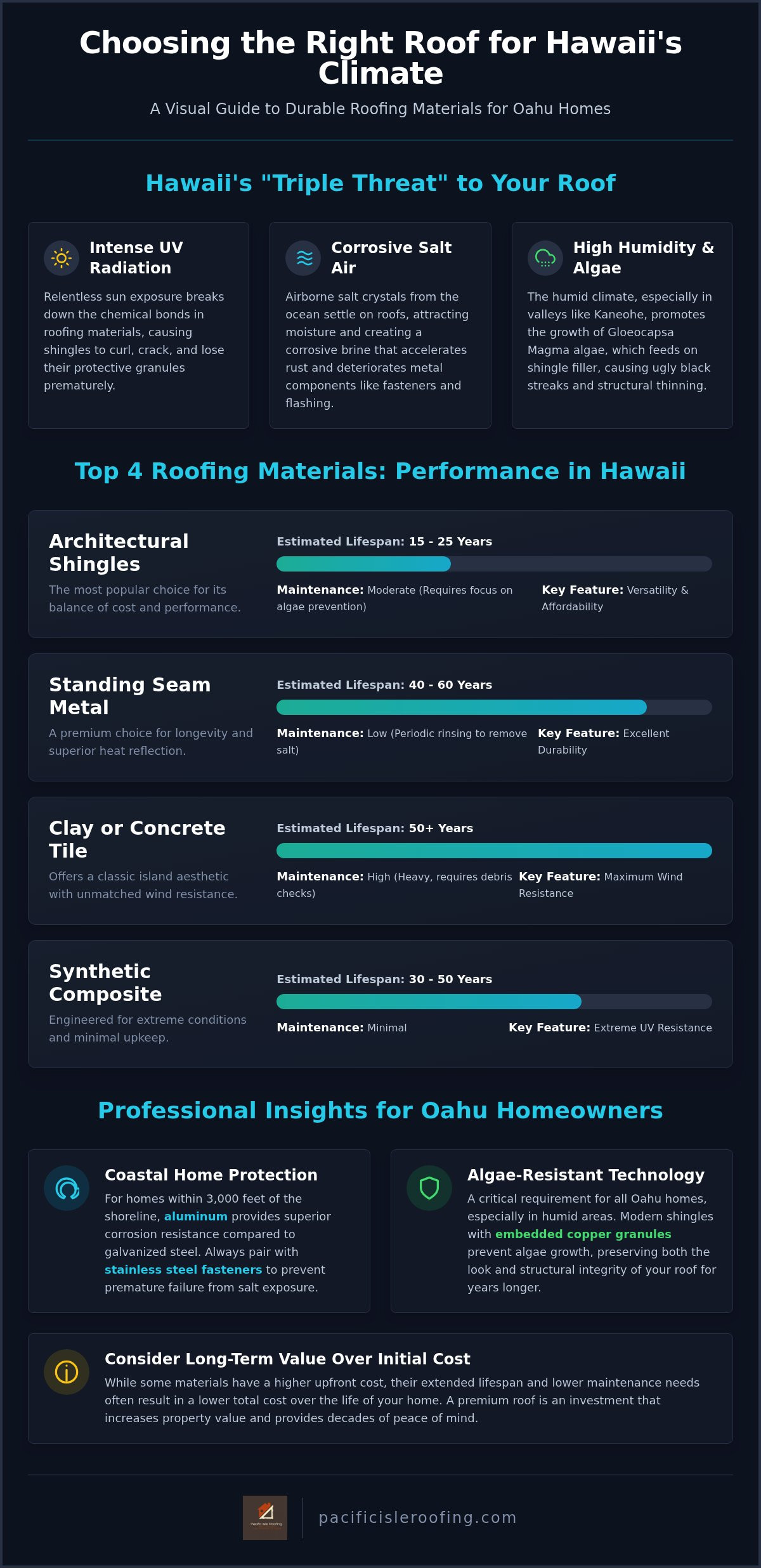
Oahu presents a unique set of challenges that can degrade standard building materials in half their expected lifespan. While traditional Hawaiian roofing relied on natural fibers to breathe in this environment, modern residential structures require high performance systems. The primary adversary is the "Triple Threat": relentless UV radiation that breaks down chemical bonds in shingles, high humidity that fosters organic growth, and airborne salt that eats through metal.
Daily temperature swings cause significant thermal expansion. Your roof might reach 150 degrees under the midday sun before a sudden tropical shower drops the temperature by 40 degrees in minutes. This constant cycling puts immense pressure on roofing joints and fasteners. Over time, this stress leads to cracks and separation. Additionally, the consistent trade winds don't just provide a breeze; they create pressure differentials that can lift shingles and force moisture into the smallest gaps. Choosing the best roofing materials for Hawaii climate requires a neighborhood-specific strategy that accounts for your exact street's exposure to the elements.
The Impact of Salt Air on Oahu Coastal Homes
Coastal neighborhoods like Aina Haina and Ewa Beach experience a high concentration of airborne salt crystals. These crystals settle on your roof and attract moisture, creating a corrosive brine. This process accelerates the oxidation of traditional metal fasteners and flashings. For homes located within 3,000 feet of the shoreline, we recommend using stainless steel fasteners and salt-resistant coatings. Without these specialized components, a standard roof replacement may fail long before its warranty period ends.
Humidity and the Battle Against Roof Algae
High humidity levels, particularly in lush valleys like Kaneohe or Manoa, create the perfect breeding ground for Gloeocapsa Magma. These are the black streaks often mistaken for dirt. This cyanobacteria feeds on the limestone filler in many asphalt shingles, eventually thinning the material and reducing its UV protection. Beyond aesthetics, trapped moisture leads to structural rot in the roof deck if the system cannot dry out properly. High humidity levels significantly shorten the functional lifespan of standard organic underlayment by preventing the evaporation of trapped condensation.
The Top 4 Roofing Materials for Hawaii Residential Homes
Selecting the right roof requires balancing immediate costs with the long term reality of island living. While many products perform well on the mainland, only a few truly qualify as the best roofing materials for Hawaii climate. Each option offers a different profile of durability, aesthetic appeal, and resistance to the environmental stressors we discussed previously. Understanding these differences is the first step toward a secure home.
Asphalt shingles remain the most common choice for Oahu residential roofing due to their versatility and initial affordability. Modern architectural versions provide better wind resistance than older styles. Metal roofing, specifically standing seam systems, has gained significant popularity for its superior heat reflection and impressive lifespan. For those seeking a classic island aesthetic, clay and concrete tiles offer unmatched wind resistance, though their weight requires a sturdy structure. Finally, synthetic or composite roofing is emerging as a high performance alternative, engineered specifically for extreme UV resistance and minimal maintenance.
| Material Type | Estimated Lifespan (Hawaii) | Maintenance Needs |
|---|---|---|
| Architectural Shingles | 15 to 25 Years | Moderate (Algae focus) |
| Standing Seam Metal | 40 to 60 Years | Low (Rinse salt) |
| Clay or Concrete Tile | 50+ Years | High (Weight/Debris) |
| Synthetic Composite | 30 to 50 Years | Minimal |
Performance Comparison: Cost vs. Longevity
When analyzing your investment, it's vital to look beyond the installation day. A material that costs less today might require a full replacement in fifteen years, effectively doubling your long term expenses. In the Honolulu real estate market, a premium roof often increases property value and buyer confidence. Metal and synthetic options frequently provide a better return on investment because they withstand the UV index and salt air without the rapid degradation seen in entry level products.
Wind Resistance and Tropical Storm Readiness
Hawaii building codes are among the strictest in the nation regarding wind uplift. Your roof must act as a cohesive shield during tropical storms. Heavier materials like tile provide natural resistance but can stress the framing of older Oahu homes. This makes the precision of a professional roof installation Oahu HI absolutely critical. Every fastener and flashing must be placed with disciplined accuracy to ensure the system doesn't fail when the trade winds intensify. If you're unsure about your current structure's capacity for heavier materials, a professional roofing inspection can provide the necessary clarity before you commit to a new material.
Asphalt Shingles: Why They Remain the Most Popular Choice
Asphalt shingles serve as the reliable workhorse for Oahu residential properties. While homeowners have many options, architectural shingles often emerge as one of the best roofing materials for Hawaii climate due to their specific balance of performance and accessibility. The transition from traditional 3-tab shingles to modern architectural versions represents a significant leap in home protection. These dimensional shingles utilize multiple layers of fiberglass and asphalt; this design provides the necessary weight and thickness to resist the high-velocity trade winds that often buffet Oahu neighborhoods.
Modern shingle technology has evolved to meet Hawaii's environmental demands through two critical innovations. First, algae-resistant technology is now a non-negotiable feature. These shingles are manufactured with copper-containing granules that prevent the growth of black streaks, maintaining the roof's integrity in our humid valleys. Second, the "Cool Roof" revolution has introduced shingles with highly reflective granules. These specialized components bounce solar heat back into the atmosphere, which helps lower attic temperatures and reduces the strain on your air conditioning system during the sweltering summer months.
One of the most practical advantages of this material is its modular nature. If a single area is damaged by a fallen branch or a localized leak, the individual shingles can be replaced without disturbing the entire system. This accessibility makes shingles an ideal choice for efficient roof leak repair Honolulu. It allows homeowners to address minor issues promptly before they escalate into structural concerns, ensuring the long-term security of the residence.
Selecting the Right Shingle Brand for UV Protection
The intensity of the tropical sun can cause inferior shingles to become brittle and lose their protective granules prematurely. We prioritize brands that utilize high-quality ceramic-coated granules, as these provide superior color retention and UV deflection. When reviewing warranties, it's vital to understand that "limited lifetime" coverage often carries specific local stipulations regarding installation standards. In high-UV areas like Kapolei, premium architectural shingles typically maintain their structural integrity for 18 to 22 years when properly maintained.
Maintenance Tips to Extend Shingle Life
Proactive care is the most effective way to protect your investment. Following consistent residential roofing maintenance tips can add years to your roof's functional life. Clogged gutters are a primary cause of shingle edge rot; when water backs up, it seeps into the roof deck and weakens the perimeter. After a significant Kona storm, we recommend a visual inspection from the ground to check for excessive granule loss in your downspouts. This is often the first sign that your shingles are nearing the end of their effective lifespan and require professional attention.
Metal and Tile: Premium Solutions for Long-Term Security
While shingles offer versatility, metal and tile provide a level of permanence that many Oahu homeowners prioritize. These systems represent a significant investment in your property's future. They are often considered the best roofing materials for Hawaii climate when the goal is a 50 year horizon. Moving beyond standard materials requires an understanding of how these premium options interact with our specific environment, particularly regarding salt exposure and structural weight.
Standing seam metal has become the gold standard for water tightness and wind resistance. This system utilizes raised seams that house the fasteners under the metal skin, protecting them from the elements. When choosing between metals, aluminum is the superior choice for coastal Oahu. Unlike galvanized steel, which eventually succumbs to rust in our salt air, aluminum creates its own protective oxide layer. This prevents the deep corrosion that can compromise a roof's integrity in neighborhoods like Ewa Beach or Hawaii Kai.
Concrete tiles offer a different set of advantages, primarily their unmatched durability against fire and high velocity winds. Their heavy mass makes them difficult for even the strongest trade winds to lift. Beyond performance, tile provides a classic island aesthetic that complements Mediterranean and Contemporary Hawaii architecture. It's a sophisticated look that signals quality and long term stability to any observer.
The Energy Efficiency of Metal Roofing
Modern metal roofs are highly effective at managing heat. Specialized "cool metal" coatings can reflect up to 70% of solar energy, which can reduce attic temperatures by up to 30%. This thermal efficiency is a major benefit during our humid summer months. Metal is also 100% recyclable, making it an environmentally responsible choice for the islands. When we pair these materials with proper ridge and soffit ventilation, the result is a significantly more comfortable living environment and lower utility costs.
Structural Considerations for Heavy Tile Roofs
The weight of concrete or clay tile is a serious consideration for any residential structure. Before you commit to this material, a professional roof inspection Honolulu is vital to ensure your home can support the load. Switching from shingles to tile often requires reinforcing the roof trusses to meet current building codes. While this adds to the initial project scope, the reward is a roof that may be the last one you ever buy. If you are ready to explore these premium options for your home, you can schedule a professional roofing consultation to evaluate your home's structural capacity and material needs.
Selecting Your Material: The Pacific Isle Roofing Approach
At Pacific Isle Roofing, we don't believe in a one-size-fits-all solution for Oahu homes. Our approach begins with a neighborhood-specific assessment. We evaluate how the trade winds interact with your specific street and measure your home's proximity to the shoreline. This data helps us determine the best roofing materials for Hawaii climate based on your property's micro-climate. Whether you face the salt spray of the North Shore or the heavy rains of the windward side, our recommendations are grounded in two decades of local observation.
Our 'Right-Fit' philosophy focuses on balancing your personal budget with long-term durability and aesthetic preferences. We provide honest professional advice without technical jargon. We want you to feel confident in your decision. Our commitment to residential excellence means we prioritize the details that protect family homes. We stay current with Oahu's evolving building codes to ensure every installation meets the highest standards of safety and integrity. We've seen how the "Triple Threat" of UV, salt, and humidity affects different materials over time, and we share that knowledge openly with every homeowner.
The Consultation Process: What to Expect
We move methodically from the initial inspection to the final proposal. You'll receive material samples to see how they look against your siding and under our unique island light. We also help you navigate the complexities of Oahu building codes for roof replacement. This includes ensuring your chosen system meets wind uplift requirements. A typical residential replacement usually takes between five to ten business days, depending on the material and the complexity of the roof's pitch. We maintain a clean job site and provide regular updates so you're never left wondering about the status of your project.
Why a Local Specialist Matters
Choosing a contractor who lives and works in your community offers a layer of accountability that transient service providers cannot match. With over 20 years of history on Oahu and our license C-42-31088, we've built our reputation on reliability and craftsmanship. We aren't just installers; we're your neighbors. We understand the high stakes of home protection in Hawaii and take that responsibility seriously. Our residential focus means we give your family home the attention to detail it deserves. If you're ready to secure your home's future, schedule your professional roofing inspection today.
Securing Your Oahu Home for the Decades Ahead
Choosing a new roof is one of the most significant decisions you'll make for your property's longevity and safety. We've explored how the "Triple Threat" of salt, sun, and humidity demands a specialized approach to material selection. From the energy efficiency of modern metal to the reliable performance of architectural shingles, the best roofing materials for Hawaii climate are those that balance immediate protection with long-term structural integrity. Your home deserves a system that is precisely calibrated for its specific neighborhood and exposure levels.
At Pacific Isle Roofing, we bring a specialized residential focus to every project we undertake. With over 20 years of local history and our Oahu license C-42-31088, we remain dedicated to providing the craftsmanship and honest guidance our community expects. We understand the high stakes of home protection and prioritize your peace of mind throughout the entire process. Don't leave your home's most critical defense to chance. Protect your home with Oahu's residential roofing experts, Get a Free Inspection. We look forward to helping you build a safer, more durable future for your family home.
Frequently Asked Questions
What is the most durable roofing material for a home near the ocean in Hawaii?
Aluminum is widely considered the most durable option for homes located directly on the coast. Unlike steel, aluminum does not rust when exposed to constant salt spray; it forms a protective oxide layer that maintains structural integrity over decades. Concrete tiles also perform exceptionally well against coastal winds and corrosion, though they require a robust support structure to handle their significant weight.
How much does a new roof typically cost on Oahu in 2026?
Roofing costs on Oahu in 2026 are influenced by rising material logistics and local labor rates. While specific project totals vary based on square footage and material choice, homeowners should account for permit fees and the 25 percent rule in Honolulu. This regulation mandates a full replacement if repairs exceed a quarter of the roof area, making it essential to budget for a complete system.
Can I install a metal roof over my existing asphalt shingles?
While you can technically install metal over shingles, we generally advise against it for residential properties on Oahu. Trapping old shingles beneath metal can lead to moisture buildup and heat retention, which may compromise the new system's lifespan. A clean tear-off allows for a thorough inspection of the roof deck and ensures the new installation meets all current building codes for wind resistance.
How often should I have my roof inspected in Hawaii?
You should schedule a professional inspection at least once every year to account for the unique stressors of the islands. Hawaii's intense UV rays and high humidity can cause materials to degrade faster than in more temperate climates. Regular checkups help identify early signs of UV damage or organic growth before they lead to costly interior leaks or structural rot.
Does a 'cool roof' really lower my electricity bill in Honolulu?
A cool roof can significantly lower your electricity bill by reflecting solar energy away from your home. By utilizing the best roofing materials for Hawaii climate, such as reflective shingles or metal coatings, you can reduce attic temperatures by up to 30 percent. This thermal efficiency means your air conditioning system doesn't have to work as hard to maintain a comfortable temperature.
What are the signs that my Hawaii roof needs immediate replacement?
Immediate signs of failure include widespread curling of shingles, significant granule loss in your gutters, and visible daylight in the attic. If you notice persistent dampness or mold on your ceiling after a tropical downpour, the internal structure may already be compromised. These indicators suggest that the protective layers have reached their limit and can no longer defend against the elements.
Are there specific roofing warranties that cover salt air damage?
Many standard warranties include a coastal exclusion that limits coverage for homes within a certain distance of the ocean. However, premium aluminum and specific tile products offer warranties that specifically address salt air corrosion. It's vital to review the fine print with a professional to ensure your chosen material provides the best roofing materials for Hawaii climate for your home's exact geographic location.
How long does it take to replace a residential roof in Hawaii?
A typical residential roof replacement on Oahu takes between five and ten business days to complete. The exact timeline depends on the size of your home, the material being installed, and the current weather conditions. While asphalt shingles are generally faster to install, premium tile or standing seam metal systems require more precise labor and additional time for structural reinforcements.


